BEAUTY, FALSE ADVERTISING, & AMERICAN COSMETIC INDUSTRY (Copy)
ATTENTION ALL SHOPPERS: LET'S TAKE THIS REAL BEAUTY CONVERSATION INTO OUR OWN HANDS.
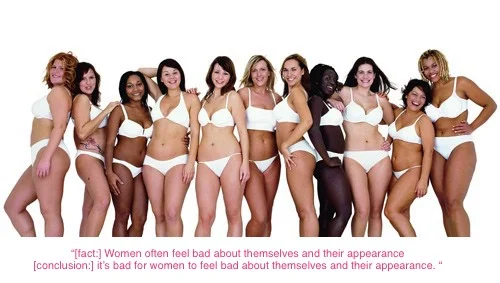
in brief: In the context of advertising, women’s self-perceptions are invented out of whole cloth, with no apparent connection to the circumstances of their lives. I go on about this in “The Girl,” which is basically “a woman” we use in advertising but she is not real, by the time she is featured in an ad so much has been done to her that there’s barely a trace of a real woman left. The Girl - our advertising currency - lives in images, only, covering pages of magazines, in a diorama of our planet, where her life and value and integrity are based purely off whatever she is advertising. And so we have the marketing landscape as we know it now, courtesy of Dove: gentle, millennial pink, and passive-aggressively reproachful of women who have allowed themselves to feel bad about their bodies. On top of all the old, existing insecurities, Dove posited that women might adopt a lucrative new one: shame over feeling bad in the first place. The brands had become self-aware, and an idea broadly known as body positivity hit the big-time.
———————
(Last edit May 2019). In June of last year, I read an article on Dove’s campaign for Real Beauty on Racked, and another article in Huffington Post, and I saved the link to eventually write a blog bc it hit me in that place… that oh-no-you-didn’t + #OMGWTFBBQ + real,-is-this-fuh-place?! This type of advertising campaign has destroyed the relationship between brands and their customers.
These ad campaigns are TOXIC. Most beauty ads are. Because I’m worth it? Really…how about you’re not worth ANYTHING. Your makeup is garbage and so are your ads. That’s just the #NAKEDTRUTH. In the next paragraphs I will elaborate on the Racked and Huffington Post articles I reference.
(8 minute read!)
lets start at the beginning: open any magazine and what do you see? Images of “a girl” - without an identity - except for the product she is advertising for. young girls and teenagers read magazines and are taught subliminally that they are not enough bc how could anyone be as beautiful as this girl - who, literally, is airbrushed to the point that her skin is flawless. coming from a strong background in advertising, and an education where I studied the psychology of advertising on teenage psyche, it’s a sad story. The Girl - as I’ve come to call her - is truly a modern day diety. She is a Goddess that most young women look up to and want to be yet she is not real (both literally in that she is airbrushed and her identity is only defined by a commodity).
DOVE “Real Beauty” ADVERTISING CAMPAIGN / SUBLIMINAL MESSAGING & IRONY
Racked’s sub-headline read: How a movement intended to lift up women really just limits their acceptable emotions. Again.
I’d like to point out this original argument of Dove’s Real Beauty campaign before we start:
“[fact:] Women often feel bad about themselves and their appearance,
[conclusion:] it’s bad for women to feel bad about themselves and their appearance.
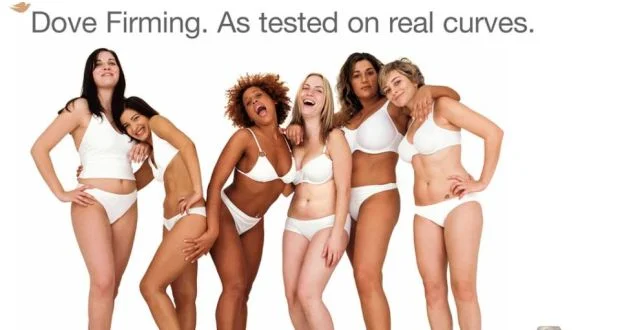
In 2004 (I know ages ago but seriously, it’s still going) a seemingly innocuous campaign for the Dove body brand of cosmetics began to pop-up in windows, in photography, then expanded to billboards, traditional print ads, and videos, all with similar messages: Women often feel bad about themselves and their appearance, and it’s bad that women feel that way. This was the Dove Campaign for “Real Beauty”.
The campaign first gained wide acclaim simply by showing a time-lapse version of a model in a faux beauty ad being photoshopped to unattainable perfection. The video contained no narration, but it demonstrated the manipulative nature of beauty advertising on both a level that ad giant Ogilvy & Mather intended and one it probably didn’t.
This was more than a decade ago, when the phrase “Facetuned Instagram” was total nonsense on a literal level, and an admission of photo editing still felt subversive to average consumers. The brands had been naughty, and Dove would gladly accept the praise for noting its own bad behavior.
The problem with using subversion as a corporate marketing tactic, though, is that if the brand is successful at it, the point it’s making becomes immediately non-subversive. And Dove was very successful at it —
the beauty industry had always worked so hard to obscure its tactics and encode its negativity that many consumers felt understandably relieved to see the manipulation acknowledged, even if the only solution Dove offered was the opportunity to buy its products.
“Ten years after the exhibition opened, the Campaign For Real Beauty is one of modern marketing’s most talked-about “success” stories. The campaign has expanded from billboards to television ads and online videos: The 2006 video, “Evolution,” went viral before “viral” was even a thing. (After all, YouTube had only launched the year before.) And Dove’s 2013 spot “Real Beauty Sketches,” which shows women describing their appearances to a forensic sketch artist, became the most-watched video ad of all time.” - HUFF POST. This is the kind of clean up they had to do, after their message worked too well, and now it’s all been tied with a bow to make it look like the best campaign EVER….right. More manipulation.
As the viral campaign helped cultural knowledge of image editing spread rapidly, beyond just people who read the feminist websites that had long been critical of the practice, Dove had to up the ante. It did so by devising a series of ads that put unsuspecting women in various contrived situations — choosing to walk into a building through doors labeled “beautiful” or “average,” for example, or being spontaneously required to describe their faces to a sketch artist.
Those sketches were then compared to others’ descriptions of them, revealing for ad viewers just how much these women hate themselves. In the case of the door experiment, it’s unclear why anyone with a functional knowledge of how averages work could reasonably expect all women to consider their appearances “above average.”
That these later ads leave out any larger agent responsible for the body image epidemic isn’t a mistake. Dove and its ad agency had picked up on something important in the positive response to its first ad: They didn’t need to take responsibility or propose a solution. While the logical continuation of that thought for anyone who doesn’t work at an ad agency would be that maybe brands should mind their business instead of dabbling in ineffective cultural criticism — that maybe they’re not the institutions we should be looking to on these topics at all — they saw an opportunity.
AND THIS IS WHAT REALLY GETS ME: The cultural narrative about women’s bodies was so bad that simply identifying the problem would get Dove full credit and move plenty of product, but the urge to talk about a broad cultural problem while refusing to name a bad actor left the blame squarely on the shoulders of the women who had the temerity not to love themselves sufficiently.
THE URGE TO TALK ABOUT A BROAD CULTURAL PROBLEM WHILE REFUSING TO NAME A BAD ACTOR LEFT THE BLAME SQUARELY ON THE SHOULDERS OF THE WOMEN WHO HAD THE TEMERITY NOT TO LOVE THEMSELVES SUFFICIENTLY
The enormous public success of Dove’s ads flipped a switch in the minds of other people in the attention business. The Real Beauty campaign launched a thousand imitators, but not because it inspired a wave of genuine self-reflection in the people who make a living inventing things for women to feel bad about. Instead, it taught brands like Aerie and Target, which have both received waves of positive public attention for Photoshop-free campaigns, that they could get exposure for pennies on the advertising dollar if they created content that people felt compelled to share themselves, above and beyond paid placements.
For that, Ogilvy execs should probably be tried at the Hague for war crimes, but I’d settle for the broad acknowledgment that body positivity, as we know it in 2019, is a load of horse shit.
Like most ideas that become anodyne and useless enough for corporate marketing plans, “body positivity” didn’t begin that way — it started out radical and fringe, as a tenet of the fat acceptance movement of the 1960s. Back then, body positivity was just one element of an ideology that included public anti-discrimination protests and anti-capitalist advocacy against the diet industry, and it made a specific political point: To have a body that’s widely reviled and discriminated against and love it anyway, in the face of constant cultural messaging about your flaws, is subversive.
Now body positivity has shed its radical, practical goals in favor of an advocacy that’s entirely aesthetic and a problem that can be wholly solved by those looking to sell you something.
The brands previously thought you should feel one way about yourself, and now they have decided that’s no longer appropriate for their goals. How you talk about yourself should change, even if nothing has changed that would materially affect how you feel.
The way these companies see it, our self-perception is unrelated to the external forces that determine the circumstances of our existence, which is why they think telling us to do better is enough to absolve them of responsibility. When brands offer solutions like using bigger models or those with more varied skin tones, or vowing that cellulite or stretch marks will survive their ads’ retouching process, they’re just barely eliding the fact that they think the problem is all in your head. Show you some different pictures and everything will get better, right?
BODY POSITIVITY HAS SHED ITS RADICAL, PRACTICAL GOALS IN FAVOR OF AN ADVOCACY THAT’S ENTIRELY AESTHETIC
Why a corporation’s opinions about anyone’s self-worth should matter or be seen as a legitimate sales tool for consumer goods is still unclear, but that dynamic has given rise to an entrepreneur class of its own. For instance, a conventionally attractive Instagram model clapping back at her haters, or a literal supermodel who feels the need to publicly answer her anonymous, powerless social media critics. Or that supermodel’s cousin who is a hero to women everywhere for displaying one single fat roll (again, on Instagram).
An alarming percentage of the public conversation about which bodies our culture values or rejects pivots around models, actresses, and other professionally beautiful people reassuring what they seem to believe is a dubious public that they are, in fact, super hot.
It’s true at this point that there’s nothing capitalism can’t alchemize into a business opportunity, but for it to be a useful tool for marketers, body positivity needed to be decoupled from fatness and political advocacy, sanitized, and neatly repackaged into something that begins and ends with images. So now, what we talk about when we talk about our physical selves is who gets to be thought of as pretty and who doesn’t, as though personal beauty is an obligatory part of a fulfilling life.
Brands have done such a good job at setting tight boundaries on our expectations and their own responsibilities that even when we chide fashion designers for not being size-inclusive on the runway, we gloss over the reason they’re not: The vast majority of fashion brands make no size-inclusive clothing and don’t see people with different bodies as worthy of being their customers.
Everlane recently launched a new underwear line featuring a plus-size model in its ad campaign, despite making no actual plus-size underwear for sale.
SO WHAT CAN WE DO? HOW CAN REAL CHANGE HAPPEN?
Let’s ban United States beauty products until they are created and advertised with the same standards as the EU. Did you know there are 1300 chemicals banned in the EU in all the Cosmetic Products because they’ve been linked to harmful effects? And that only 11 of those are banned in the USA? I, Liz Ash, will stand with every woman and do as much as I possibly can to #banstorebrands and provide home created solutions if we make March thru June. Will you join me as #LIZASHBEAUTYBANDITS so we can at least be treated with the same respect the EU is? This country needs to stop taking our money and EARN IT. #BEAUTYKISSOFDEATH #LIZASHUSAISBEAUTY #USACOSMETICBAN #BYEBYEBUYBUYBEAUTY